.png)
도시 나무 식재 서비스 개발
- BIST SKKU
- 4월 8일
- 2분 분량

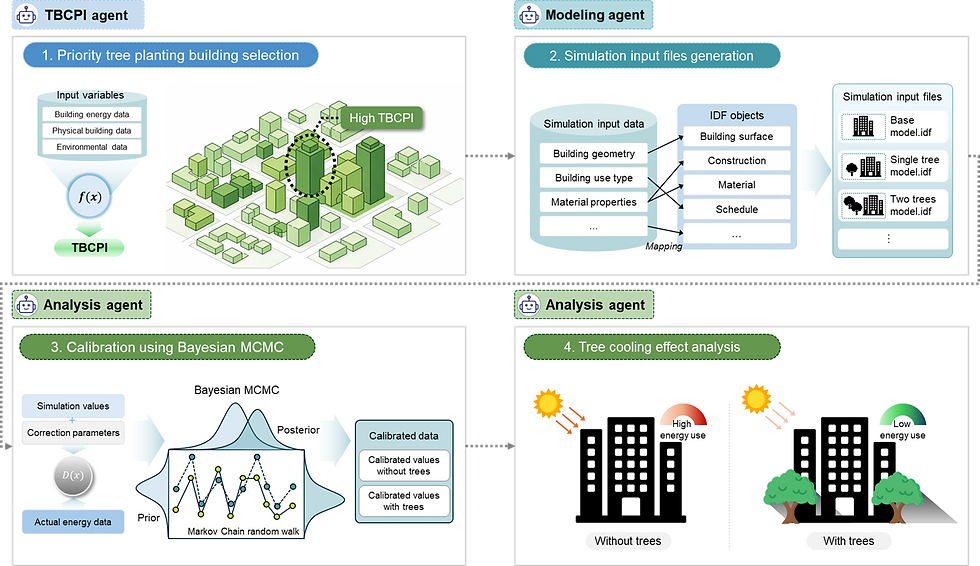
본 연구에서는 건물 중심의 나무 식재 전략을 제안함. 기존 연구는 주로 어떤 나무를 어디에 심을지에 초점을 두었지만, 본 연구는 어떤 건물에 나무를 심어야 에너지 절감 효과가 더 크게 나타나는지를 분석함. 이를 위해 건물의 물리적 특성, 에너지 사용 특성, 그리고 주변 도시환경을 종합적으로 반영한 Tree-Based Cooling Potential Index (TBCPI)를 개발함.
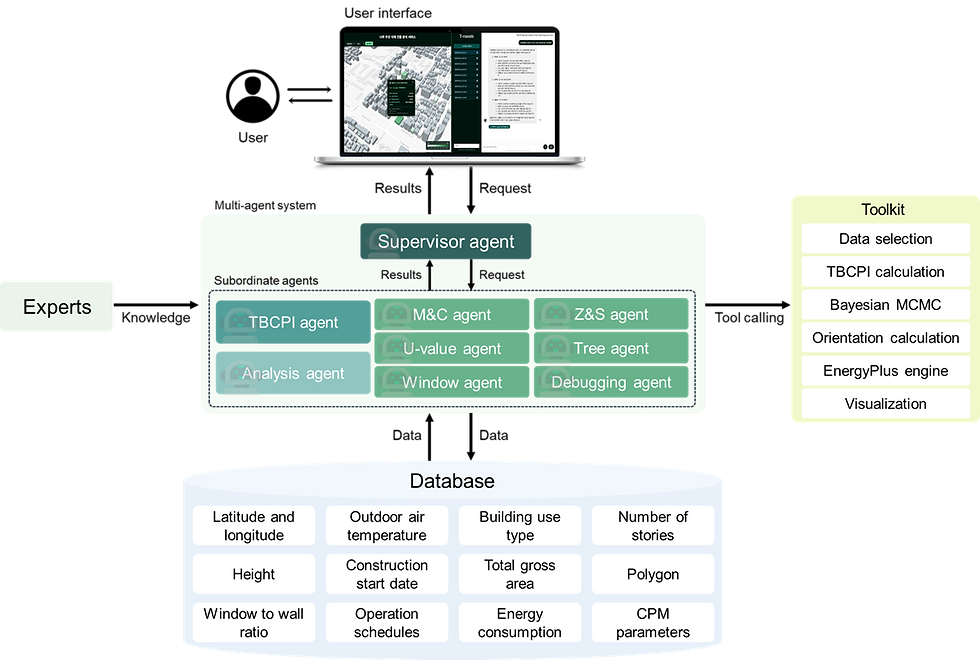
또한 실제 도시 적용 가능성을 높이기 위해 LLM 기반 멀티 에이전트 시스템을 구현함. 이 시스템은 후보 건물의 우선순위를 산정하고, 선택된 건물에 대해 자동으로 에너지 시뮬레이션 입력파일을 생성한 뒤, 실제 에너지 사용량을 바탕으로 보정을 수행하여 나무 식재에 따른 냉방 에너지 절감 효과를 정량적으로 분석함.
본 연구는 1) 도시 나무 식재를 ‘건물 중심’ 관점에서 재해석하고 2) TBCPI를 통해 식재 우선 건물을 선별할 수 있는 정량적 기준을 제시했으며, 3) LLM 기반 에이전트 시스템을 통해 도시 규모에서 활용 가능한 자동화 서비스의 가능성을 보여줌
본 서비스는 아래 링크를 통해 확인할 수 있다.
This study proposes a building-centered tree planting strategy. While previous studies have mainly focused on what trees to plant and where to place them, this study examines which buildings should be prioritized to maximize energy savings. To this end, the Tree-Based Cooling Potential Index (TBCPI) was developed by integrating building physical characteristics, energy-use characteristics, and the surrounding urban environment.
To enhance practical applicability in real urban contexts, an LLM-based multi-agent system was also implemented. The system prioritizes candidate buildings, automatically generates energy simulation input files for selected buildings, and calibrates simulation results using actual energy consumption data to quantitatively assess the cooling energy-saving effects of tree planting.
This study 1) reinterprets urban tree planting from a building-centered perspective, 2) presents a quantitative criterion for identifying priority buildings through the TBCPI, and 3) demonstrates the potential of an LLM-based agent system as an automated service applicable at the urban scale.
The service is available at the link below.



댓글